Rethinking Cloud: autonomous infrastructure with human intent
The more I work with the new wave of AI tools, the more I realize we need to rethink the cloud entirely. We are still operating clunky dashboards when we should be having a conversation with an intelligent architect. We need to move from a passive cloud that waits for instructions to an autonomous cloud that understands intent and acts upon it, with human governance at the critical junctures.

Bas Tichelaar
Managing Director
Right now, the cloud is a massive collection of powerful resources abstracted into small pieces, accessible via APIs. But for most of us, it has become a nightmare of manual glue. We spend more time acting as the middleware between disparate services—picking instance sizes, configuring VPC peering, wrestling with vendor lock-in—than we do building our actual products.
The more I work with the new wave of AI tools (Opencode mainly), the more I realize we need to rethink the cloud entirely. We are still operating clunky dashboards when we should be having a conversation with an intelligent architect.
We need to move from a passive cloud that waits for instructions to an autonomous cloud that understands intent and acts upon it, with human governance at the critical junctures.
Here is a vision for the cloud of the future.
The core shift: from manual glue to autonomous agents
In modern software development, we focus on logic and requirements; the underlying CPU architecture is an implementation detail. The cloud needs the same paradigm shift.
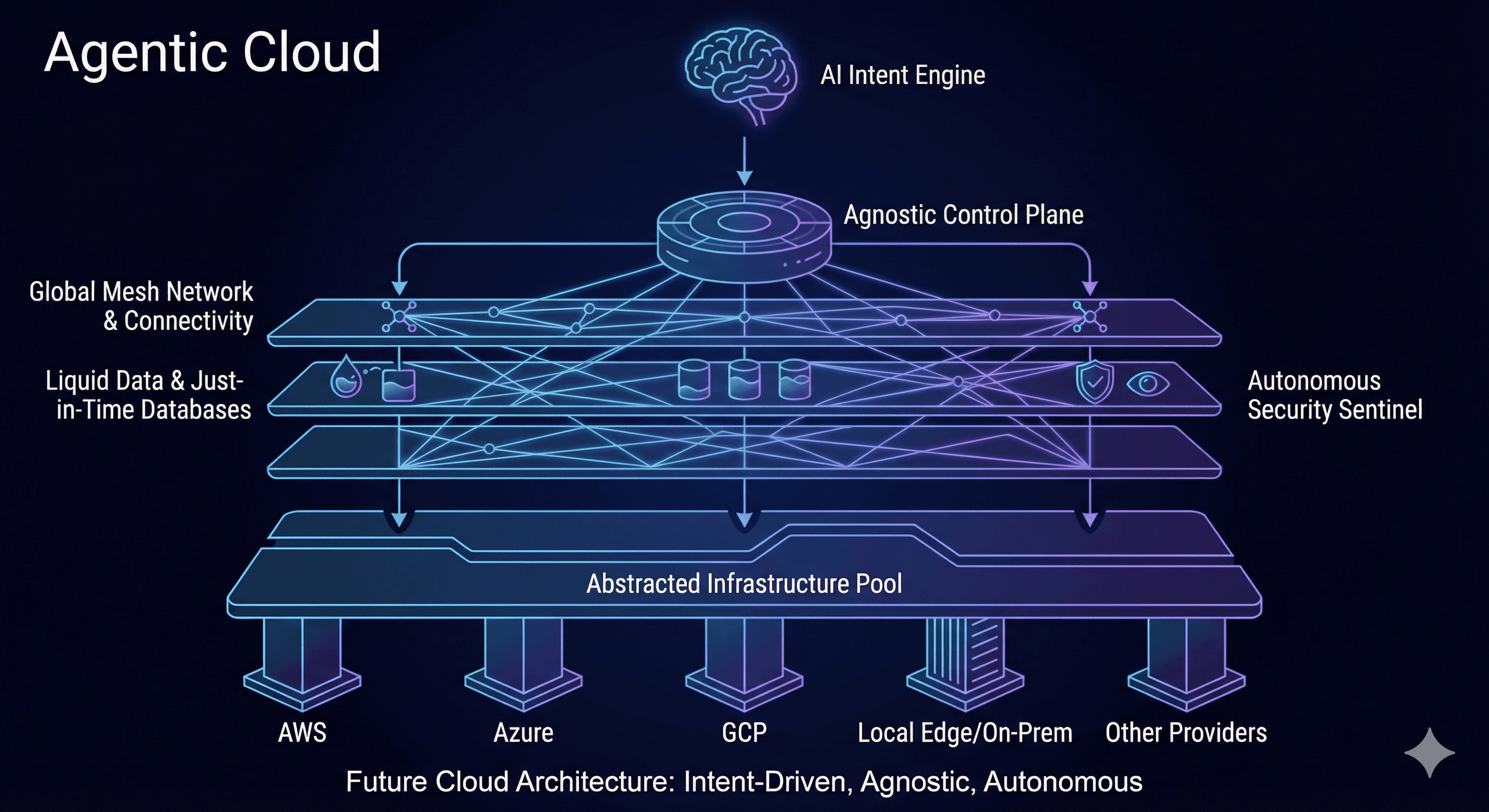
The future infrastructure isn't just "automated" via scripts we write; it is autonomous. It is a living mesh of AI agents designed to constantly optimize your application based on the parameters you define. It’s like a self-driving car: it handles the complex, second-by-second navigation, but you set the destination and approve major route changes.
To make this work, we need to redefine the core pillars of cloud computing:
Redefining autoscaling: intelligent cross-provider placement
This is the biggest change. Today, "autoscaling" usually means: "When CPU hits 80%, add another expensive instance in the same AWS region." It’s reactive and provider-locked.
In an autonomous cloud, scaling is predictive and agnostic.
Imagine an agent that notices a growing trend in traffic from Brazil. It doesn't just blindly scale up your US-East infrastructure. It actively researches the current spot market prices across AWS, Azure, Google Cloud, European cloud providers like Scaleway and Upcloud and local bare-metal providers like Hetzner. It calculates the latency benefits versus the egress costs.
It might conclude: "Moving the read-replica and front-end workers to a local provider in Sao Paulo will decrease latency by 120ms and save 30% on costs compared to scaling existing infrastructure." It then prepares the migration plan and presents it for human approval.
Autonomous execution with human governance
For agents to be truly effective, they need direct access to deploy resources and make them public. They cannot just be chatbots offering advice.
However, this autonomy must be paired with a robust "human-in-the-loop" framework for critical decisions.
Routine tasks are autonomous: Patching a minor OS vulnerability, rotating keys, or slightly increasing cache size should happen automatically.
Strategic moves require approval: Migrating a production database across international borders or changing the underlying storage engine from SQL to NoSQL triggers an approval workflow. The AI proposes the architecture and the budget; the human clicks "Approve."
Just-in-time resources & the immune system
Fluid databases: You shouldn't have to permanently provision a database. You define a data need. The system selects the right engine and instantiates it. If your access patterns change, the autonomous agent handles the complex migration to a more fitting database type.
Security as a real-time immune system: Instead of weekly static analysis scans, a continuous security agent monitors system calls and network traffic in real-time. It autonomously isolates threats the moment they appear, much like a biological immune system responding to a virus.
Is this feasible today?
We are closer than you think. The "plumbing" for an agnostic control plane already exists through technologies like Wireguard for mesh networking and Crossplane for abstracted provisioning. The challenge now is the intelligence layer: training agents to understand the nuance of business intent and building the governance interface that allows humans to trust the machine.
Focus on outcome, not output
The benefit of an autonomous, agentic cloud is that it finally aligns infrastructure with business value. You stop asking "How many pods do we need?" and start asking "What are my constraints?"
The deployment flow of the future looks like this:
Developer defines intent: "Deploy this e-commerce app. Keep EU latency under 50ms, ensure GDPR compliance, and cap the budget at €1,000/month."
Autonomous agent plans & proposes: The agent analyzes the constraints and devises a multi-cloud architecture that meets the latency and budget goals, perhaps utilizing a mix of serverless functions and reputable local providers.
Human acts as governor: The developer reviews the proposed architecture, cost estimates, and compliance checks. They click "Approve."
System executes & maintains: The agents deploy the infrastructure and enter continuous optimization mode.
Let’s build the future
The current state of cloud is too complex and too rigid. If we want to move fast, we have to stop acting as digital plumbers gluing APIs together. We need to become architects of intent, managing intelligent systems that handle the heavy lifting.
What do you think? Are you ready to trust an autonomous agent with your infrastructure, provided you have the final say on strategic decisions? If you’re interested in exploring how to make your infrastructure more autonomous and outcome-driven, let's connect.